Monday, 28 May 2012

We are for people. Or... are we?


Photo: Thomas Struth
I was in two meetings with museum professionals lately and another one is starting tomorrow in Lisbon (the European Museum Advisors Conference 2012). I thought about what makes me feel so good in their company. I reached the conclusion that it is the fact that these are people who give, whose work makes sense to them because they´re eager to share it, they want it to be useful and meaningful to others. There was not even one award or special commendation in the recent European Museum of the Year Award ceremony in Penafiel (Portugal) that did not mention the special relationship or involvement those museums have established with their communities. Museums are moving, even if still slowly, from collection-oriented to people-oriented institutions.

It might sound strange that I say ‘slowly’. But let´s consider this: it was in 1909 that John Cotton Dana, visionary director of the Newark Museum in the US, expressed the following view on the role of museums: “A good museum attracts, entertains, arouses curiosity, leads to questioning and thus promotes learning. (...) The Museum can help people only if they use it; they will use it only if they know about it and only if attention is given to the interpretation of its possessions in terms they, the people, will understand”. And it was in 1917 that he wrote: “Today, museums of art are built to keep objects of art, and objects of art are bought to be kept in museums. As the objects seem to do their work if they are safely kept, and as museums seem to serve their purpose if they safely keep the objects, the whole thing is as useful in the splendid isolation of a distant park as in the centre of the life of the community which possesses it. Tomorrow, objects of art will be bought to give pleasure, to make manners seem more important, to promote skill, to exalt handwork, and to increase the zest of life by adding to it new interests.”

Are we, almost a century later, the ‘tomorrow’ John Cotton Dana was talking about? When there are still museum directors who feel they need to make a choice between taking care of ‘their’ collections and sharing them with people, “in terms they, the people, will understand”? As if we had the right to choose which of the five museum functions we are here to fulfill (collect, preserve, research, exhibit or interpret), instead of fulfilling them all as best as we can? I don´t think we are that kind of ‘tomorrow’ yet, but very serious steps have been taken to this direction by many museum all over the world. And this attitude has paid off. Because these museums have become relevant for their communities, they are used and cherished, they are parts of people´s lives, so people are there to defend their existence.


Somehow, these collection-oriented museums made me think about artist-oriented institutions. And Vitor Belanciano´s article “Artists and Cynicism” (Público, 20.05.2012) couldn´t have come at a better moment to give me some more food for thought. In a text that was profoundly felt and appreciated by people who value artistic creation, Vitor reminded us of some truths: of the bad image culture and the majority of artists have in Portugal; of the fact that they are considered parasites; of the fact that – some, not all - 'deserve' the public´s recognition only after they pass away. He also mentioned that scientists, doctors, lawyers or engineers, even if bad professionals, don´t have to justify their existence to society; and that artists are not doing enough to seduce public opinion, probably because they don´t believe themselves in what they want us to believe in: that art doesn´t only create material richness, but also wisdom and emotional richness, which in these times is absolutely essential.

Other professions don´t have to justify themselves because they are already perceived by people as contributing to the common good. And it is clear for people in what way they are doing it. Artists are, first of all, not seen as professionals and they are also seen as working for themselves, though spending public money. Just like the institutions that give them the space to do it. But, just like museums do not exist only to preserve collections, performing arts institutions do not exist only to present artistic projects. The ‘introversion’ that still caracterizes many of them, opening the doors only to the few ‘initiated’, is being contradicted, both by the entry of professionals that bring along new concerns regarding the relationship with society – which is fundamental in order for them to fulfill their mission, as well as inextricably linked to their sustainability - , as well as by the citizens´ demand for access. 

Cultural institutions are for people. They are places of encounter among people who wish to communicate with each other; who are looking for beauty and inspiration and meaning; who wish to share thoughts, experiences, worries, joys. If those who lead them are not conscious of this, then a big part of our society will continue to consider the investment a waste, their offer incomprehensible, their existence irrelevant and, thus, disposable. 

More readings 


Monday, 21 May 2012

Guest post: "Jos Repertory Theatre: Living and working in Nigeria", by Patrick-Jude Oteh


Patrick-Jude Oteh was my colleague last year in the Kennedy Center Fellowship. I remember remaining speechless after his presentation of the work carried out by Jos Repertory Theatre, which he founded in a small and now divided nigerian town called Jos. How can a theatre company fulfill its mission in a place where people´s safety is one of the first priorities? And what is the role of that same company when operating in an environment defined by terrorism, curruption, ethnic and religious divides?

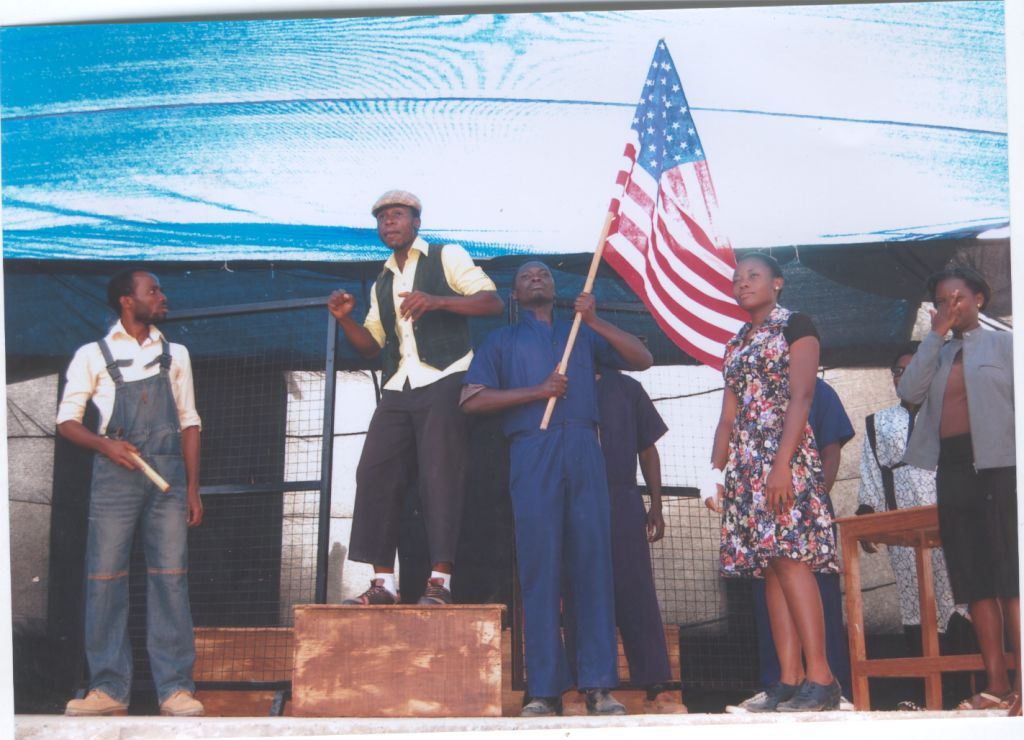
Emeka Nwabueze's When The Arrow Rebounds, the stage adaptation of Chinua Achebe's novel Arrow of God, directed by Patrick-Jude Oteh for the 2011 national tour and 2012 Jos Theatre Festival.  © The Jos Repertory Theatre Archive

I live and work in a state with a population of 3.5m people, the bulk of whom are self-employed and government workers. The people of Jos, which is the capital of Plateau State, are hardworking, energetic and welcoming. In the city, there is a healthy mix of people from other parts of Nigeria, which has 36 states, and the federal capital territory, Abuja. Plateau State used to be the only state in Nigeria where you could easily find other tribes and nationalities co-existing peacefully. Until twelve years ago.

Due to a mix of politics, economics, religious and ethnic intolerance and mass unemployment, all the various segments of this once vibrant and beautiful city now live in segregated and dividing enclaves all round the city. There is mutual distrust, agony and pain in relationships which, barely a decade ago, were being built across various divides.

Our theatre company, The Jos Repertory Theatre, started operating in this city a little over a decade ago. Then it was fashionable to hold productions at 7pm in the evening and audiences were feeling safe in a night out in the city. Not anymore. It is termed risky if we start a production by 5pm. These days most people are indoors by 7pm. The last festival in 2012 saw productions finishing at 6.30pm. We had to cancel the post performance discussions, which gave people a channel for their voices to be heard, so that people could go home on time or be in the comfort and safety of their neighbourhoods. Commerce and schools have also taken the same path. It is sad to see schools populated only by pupils of the same faith or pupils of the same ethnic stock. The markets, once vibrant spaces for social interaction and relationships, are also not spared.

Lonne Elder III´s Ceremonies In Dark Old Men, directed by Osasogie Efe Guobadia for the 2012 Jos Theatre Festival.  © The Jos Repertory Theatre Archive
The reason for this unfortunate development in the affairs of our nation, of which Jos is only but a tiny fraction of a larger malaise, is the struggle for power and for the control of national resources, as the person or group that holds political power in Nigeria is also the one responsible for sharing national resources. People are struggling to rule not because they want to serve but because they want to be the ones to decide who gets what and when. There is also a lot of mind-bending corruption, in a country so richly endowed, which has killed off so much of our time honoured values.

In the last two years, it has become very challenging to work in the theatre. We pulled off two theatre festivals, but it was done under very hard and challenging circumstances. Part of the objective of our recent work has been to use the theatre to foster dialogue and interaction amongst the various people and sides of the unending conflicts.

Due to the fact that we are being confronted with a lot of issues that seem to defy solutions, most of the time our work seems like a consistent and constant failure. You get this feeling that you are not doing enough. But then, what can you do in a situation where a lot of people do not see the need to give to worthy causes like the theatre? Five years ago, we started an initiative whereby if we could not work within our host city we would work in the nation’s capital, Abuja. Our capital has not been spared either. It is almost like we are in a perpetually boiling cauldron.

How do you keep hope alive in this environment?

We have been fortunate as a company to work with a group of young people who simply want to create and don´t want to know where or who they are creating with. They simply want to know the human being. It is not always easy keeping everyone safe within the different enclaves, but it does help to know that their generation is keen on working with each other, forging friendships and closeness that no amount of politics, religion or ethnic differences can erase. These are the future leaders of this society. They are vibrant and they are resilient. When hopes and morale are at a low, they are the ones who keep us going by their unspoken words and deeds.

Barrie Stavis´s The Man Who Never Died, directed by Patrick-Jude Oteh for the 2012 Jos Theatre Festival.  © The Jos Repertory Theatre Archive
The rise of terrorism in our country simply added another dimension to our woes. Like everything Nigerian, whenever we take on something, we always build a better model. That is what has happened with our terrorists. They are getting more and more sophisticated and along with this sophistication has come a new sense of daring. They are willing to take on everything and everyone. The government and the press are not spared. The unfortunate aspect of this presently is that there is nowhere safe in the country, except in the south, which has not experienced terrorist attacks.

This has definitely affected all aspects of our work. We cannot do any work now without thinking of security issues. When searching for a space, in an area where spaces for performances hardly exist, we have to look for upscale venues which are more expensive, which means that we have to charge our patrons enough to cover our costs, though this has the potential of driving patrons away from the theatre. They have other concerns than theatre! Another sad dimension, which is fast posing a huge challenge, is the fact that people try to avoid crowded places. So having an audience is no longer guaranteed.

Our hope is that our country will go back to what we used to know, not the present aberration that we can hardly recognize. Our hope is that one day the government will translate its words into action, especially in the provision of employment for a crucial sector in our economy. Thus far, the government has not been able to match words and rhetoric with actions. The President had promised a $200m arts intervention fund which would be made available to all arts sectors. Almost two years later, we are yet to hear of anyone who has been able to access the fund. Even the very existence of the fund has been involved in controversy, with the government now saying that the money was to build infrastructure for the arts sector. We have not seen any structure or support system for the arts in place. As an organization, we have continued to rely on individuals and some support from the corporate sector.

This is the country where I live and work. Is this the country where my kids will realize their potential? It is doubtful. However, we are a very hopeful and prayerful people.


Patrick-Jude Oteh is the Founding Artistic Director of Jos Repertory Theatre, an independent not-for-profit theatre organization in Nigeria. He studied Theatre Arts at the University of Ibadan, where he also got his Masters degree and he is currently a Doctoral candidate. He briefly taught African Drama, Directing and Acting/Speech in the Department of Theatre and Communication Arts at the University of Jos. He has been involved in theatre related projects in the USA, UK, Italy, Sierra Leone, Côte d’Ivoire, Kenya and South Africa. One of his on-going involvements is the stringing together of a group of touring theatres as well as creating a database of companies and actors in the West African sub-region. He was a Summer International Fellow at the John F. Kennedy Center for the Performing Arts, Washington D.C. He is involved in the formation of the 1st Arts Management Center in Abuja and writes a weekly column on Arts Management, called From the Live Stage, for the Peoples’ Daily Newspaper.

Monday, 14 May 2012

What´s the problem with classical music? Apparently, none...


Gustavo Dudamel (photo taken from the blog Opera Fanatics)

Gustavo Dudamel is, at this moment, the face of classical music´s popularity. I recently read that his latest album is nr. 3 on the swedish pop chart (ahead of Madonna). I don´t know whether I am wrong, but I think that we hadn´t seen something like this since the time of the three tenors. I do believe it is fortunate when one can count with the contribution of such ‘phenomena’, who, through their art and their great capacity to communicate, manage to open windows for thousands of people to things they had never experienced before. Thanks to them, this world (and also those of opera and ballet) – seen by many as closed, elitist, incomprehensible, uninteresting, ‘stuffy’ – becomes demystified, surprises, enthuses, touches, gets a place in people´s lives. In the meantime, there are many more professionals (artists, but also programming directors, managers, communication and education professionals) who also contribute, although at a different scale, so that more and more people may get in tuch with the world of classical music, discover it, share it.

Monday, 7 May 2012

Guest post: "Me, you and the others", by Eva-Kaia Vabamäe (Estonia)


I met Eva-Kaia Vabamäe during a training course last September. A few days ago, she surprised me with a text she wrote, inspired by a recent post of mine, on the challenges faced by estonian museums when presenting the history of their 20-year-old country. I asked for permission to re-publish her text. This made me think that there are always so many realities we don´t know about, so in the next few weeks there will be more texts from Spain, Brazil, Egypt, Ukraine, the USA and Nigeria. And I hope more will follow. mv

Model of the National Museum of Estonia´s new building (image taken from the website  A10.eu - New European Architecture)
Maria Vlachou, a Greek museologist who currently lives and works in Portugal, raises the topic of telling stories in the museum context in her blog Musing on Culture. She focuses primarily on how one story can sound totally different depending on the nation that is telling it (for example the never-ending conflict between neighbouring countries Greece and Turkey). This reminded me of the important role museums play when it comes to rethinking and explaining history to the public.

Coming from a tiny (although, of course, huge in spirit) country like Estonia, with a population of less than 1,5 million, we are used to imagining that we are in opposition with other nations. It’s been a survival strategy through various occupation periods, when the oppressors tried to absorb us into other, bigger, nations. Our history mostly consists of battles for our identity; battles for the opportunity to have our own republic and our own culture. Of course, that means that there has often been someone else to be opposed to, someone who has won the game by just being heavier. Therefore, success stories in Estonian history usually consist of tales about a nation that is clever as a fox, incredibly persistent and wins the fight with incredibly simple tricks (who would believe that a nation can sing itself free, but yet it’s a true story). As US anthropologist Paul Firnhaber pointed out in the Estonian NationalMuseum’s latest museums masterclass, we’ve only had one military hero, Lembitu, who lived in the 1200s and didn’t actually accomplish much.

When this background is taken into account, it is in fact not a great wonder that usually we just tell stories from our own, Estonian, point of view. We’ve only been independent again for a bit more than 20 years and before that it was the Soviet occupation, known for its habit of rewriting history to suit political ambitions. Obviously then, the historians have had their hands full with setting things right and there’s still a lot to re-evaluate. But how often do we think about how other nations have seen the same events? What would the stories of our ethnic minorities be like? What would the stories of our neighbours be like or how did it all look like on the other side of the ocean? We are only beginning to tell these stories and it will be a great challenge for a tiny nation that has mainly been fighting for its own survival.

Volunteers gathering on the pathway to Raadi Manor to clean the territory. Raadi is a place that could tell very controversial stories. Among fields and meadows, it became a Baltic German manor in the 19th century; then the Estonian National Museum’s first exhibition hall in the 1920s; then a Soviet military airfield during the cold war; and finally, in the 2000s, the area designated for the ENM building, the construction of the main building is to begin shortly. (Photo: courtesy of NME).

Like Maria Vlachou also writes, people used to turning to museums to find the “truth”. Museums have the authority to decide what and how will be displayed. This places a huge amount of responsibility on the shoulders of museum specialists, because, as I am sure each and every one of us has noticed,  there’s rarely only one ‘right’, objective, view on world history. Current museology already tells us that museums shouldn’t be the dictators of truth, but offer a variety of different narratives.  More simply put, this theory is similar to the proverb that says: “Don’t give the hungry man a fish, but a fish hook”, which means that the museum must trust its visitor enough to let him, based on these different narratives, decide for himself.

The Department of Ethnic Cultures of the National Museum of Estonia is currently helping Valga Museum with developing an inclusive exhibition project with and about the local Roma community. The start has been quite rocky, especially on the ‘inclusion’ side. We’ve had to do a lot of explaining that we’re not making any money with this project, because the Roma community has had negative experiences with former projects, when they’ve felt that they’d only been used for statistics and no real input was expected of them.

As part of the preparation process, my colleague and I attended a seminar last week. It was a seminar for teachers and a Roma woman, who runs the local cultural Roma NGO, was asked to speak about their culture. This time, like before, she again asked the question: “Why now? Nobody cared about us for hundreds of years, why now?”. I think it’s because we’re finally ready to tell more stories than just our own. And based on the question that one participant (let me remind you that they were teachers!) asked: “Why should I respect you, when I know nothing about you?”, I’d say it’s more than necessary to start telling them!

[Text originally published in the Eesti Rahva Muuseumi blog (National Museum of Estonia)]

Eva-Kaia Vabamäe currently works for the National Museum of Estonia (NME) in the Department of Ethnic Cultures. Her job is to assist different types of museums in the fields of museum education, exhibitions and communication strategies. This includes organizing workshops and courses, but also working in a variety of other museum development projects. Current projects include developing a community-inclusive exhibition hall for the NME´s new building, creating a summer programme on ethnic cultures for children, creating workshops for museum educators, the above-mentioned exhibition about the Roma community, etc. Born and raised in Estonia, she has formal training in design and conservation and lately graduated from the University of Tartu with a Master´s degree in Art History and a thesis concentrating on the elaborate historic interiors of Baltic Germans, formerly a very significant minority group, both in cultural and economic terms.

Monday, 30 April 2012

Barcelona: 1 conference, 2 museums putting it to the test


Last week I was in Barcelona for the conference Glocal Audiences in Culture: Global Cities, Local Audiences, an Audiences Europe Network initiative. There were both museums and performing arts institutions in the programme, two worlds that rarely come together to discuss issues they have in common.

Quiet often, in these conferences we get to know projects which seem to be the answer to all our wishes and worries, but whose presentation remains rather superficial. We end up not knowing how they were developed and how (and if) they have been evaluated. This conference was no exception, but, even though, there were some moments and discussions of particular interest. The programme included one introductory session and five panels, which I´ll try to brielfy summarize.


Introductory session: Tourism vs. local audiences
We were presented with the results of a visitor survey which indicates that the big majority of the spanish do not visit museums in their country, but don´t fail to do so when travelling abroad; that more than half of visitors to Barcelona museums are foreigners, while 27% reside in this city. Visitors´ perception of museums is that they mean “learning”, “curiosity”, “peace”, “admiration”, “discovery”. Non-visitors´ or occasional visitors´ perception is that they mean “boredom”, “effort”, “incomprehension”, “discovery”. Speakers mentioned the need to create a feeling of belonging among local communities, to establish emotional links, to create spaces of encounter. One must admit that this is nothing new. I was thus left thinking if it makes sense to continue investing in this sort of one-off surveys which aim to study the relationship between audiences and museums in general, instead of working with the objective to change some of these indicators. On the other hand, in the case of museums which have the means to carry out continuous surveys (we were presented here with the Louvre case), which allow them to evaluate their work over time, registering modifications and new trends, one may find, no doubt, relevant indicators of change.


Panel 1: Big museums for local audiences
The need to concentrate on the individual and adapt the offer to everyone´s needs was once again mentioned here. Is it really possible that museums like the Prado and the Louvre, which receive millions of visitors every year, are able to fullfil this objective? This is what we dind´t find out in this panel. The mere presentation of initiatives is not enough for us to understand if the objective was met. In the meantime, there were mentioned here some points that deserve to be considered: the importance of collecting, using and sharing data; of seeking new partnerships, also among smaller museums, located in the area of the 'big ones'; of stepping outside the museum boundaries and going to meet the people; finally, of considering as a performance indicator not only the number of visitors, but also whether the museum has managed to meet (or not) visitor expectations.


Panel 2: Pricing strategies in time of crisis
Here´s a panel that didn´t meet expectations. Speakers presented their discount policies – the usual ones, those which have always existed – without a special consideration, as it was expected, regarding the challenges presented by the actual economic crisis. Challenges which, in my view, mainly concern those who normally visit cultural spaces (more or less frequently) and who might now have a more limited capacity to purchase tickets. What can we do in order to provide access to those who wish to visit and guarantee a revenue for our institutions? In what concerns free entries and the illusion that they bring, just by themselves, people who don´t have the habit of visiting, there seem to exist consensus (at least, nobody expressed his/her disagreement): this is really an illusion.


Panel 3: From user to client
Some truly relevant questions were raised in this panel concerning the need to put the individual in the centre of our strategic plans, to develop new audiences (I have stopped using this expression, but this is what was said) through relationship marketing, to create proximity and a personalized service, to take advantage of Customer Relationship Management tools (in Portugal, I believe that only CCB has been using them). There was also some discussion regarding the importance of maintaining a balance between what people want and programming needs (which reminded me of the very interesting Lead or Follow debate, which took place in January and the reading of which I recommend).


Panel 4:Tourist cities for local audiences
This was, in my opinion, the most interesting panel, where we truly shared and discussed worries and thoughts regarding the tension created in cities of all sizes between the local community and tourists. There is a real need to be relevant for different audiences, which requires very specific strategies in order to nurture and maintain a relationship with local people (from special programming to offering free coffee). The most interesting case for me was Hermitage Amsterdam, which ‘insists’ on positioning itself as an international destination, when tourists don´t see it this way and the local community, with which it has already established a very strong relationship, particularly appreciates the fact that this museum doesn´t draw the hoards of tourists one finds in other museums in this city.


Panel 5: Cultural institutions take the street
And it was this last panel that kept a pleasant surprise for us. An inspiring project of great impact: The Grand Tour was a National Gallery initiative, in partnership with Hewlett Packard (HP), which spread in the city centre, sometimes in the most unexpected places, chosen with a great sense of humour, high quality copies (prints) of the gallery´s most famous paintings. The objectives were: to raise awareness regarding the museum; to inform the public that some of the most known paintings could be found in the gallery; to let them know that entry was free; to make people talk about art. Next to each copy, there was a label with some basic information about the piece and a phone number for those who wanted to know more. Information was also available on the microsite and cold be downloaded. The museum considers that mission was accomplished: the number of visitors increased significantly, and many were coming holding the map that was created for this initiative looking for the original works. In many cases, the photos speak for themselves, in the meantime, there was also a book about this experience and people´s reactions to it.

Photo taken from the blog The Crossed Cow
Photo taken from the blog The Crossed Cow
Photo taken from the blog The Crossed Cow
I took advantage of my two days in Barcelona to visit two of my favourite museums. Arriving at the Maritime Museum, I found out that the permanent exhibition was closed due to works. I didn´t remember having seen a warning on the website (available only in catalan and spanish), but I checked when I got back to my hotel: there was no warning. Thus, I visited a temporary exhibition on the Titanic. Before I entered, I looked for the cloakroom to leave my heavy bag, but there wasn´t one. Entering the exhibition, I was given an audioguide (this one, yes, in more than two languages), which obliged visitors to follow a specific path, without being able to choose which objects or sections they might want to learn more about. When cases were small, too many visitors accumulated in front of them, making it impossible to see the objects we were hearing about. I turned the audioguide off and read just a few labels. Along the different sections of the exhibition, more than once I wondered if the objects in front of me were originals or copies (a museum has the obligation to mark the difference). I approached three members of staff to ask for information about this, all very nice, but none of them spoke english.

Museu Marítim de Barcelona, Titanic exhibition  (Photo: mv)
The following day it was the turn of the Museum of the History of Catalunia, in my opinion, one of the best history museums. I was glad to see english labels this time. In the past, I couldn´t understand how at the history museum of a people who wished to proclaim their difference and autonomy that same history was not told to foreign tourists, at least in english. On the other hand, the french friend who came with me to that visit, a history teacher at the French School of Barcelona for four years now, had never heard of this museum, he was visiting for the first time (and loved it). Wouldn´t one expect that among this museum´s priority target audiences would be history teachers of the city and region?

Museu d´Història de Catalunia  (Photo: mv)

These are, yes, two of my favourite museums in this city, because they know how to tell a good story. Nevertheless, they both put the reflections and conclusions of the conference to the test and reminded me that, in many cases and even in what concerns issues that seem to be obvious or simple, theory and practice remain quite distant. Why is that?


Still on this blog


Monday, 16 April 2012

The stories we tell ourselves

Afyonkarahisar, Turkey

When I was 11 years old and our car broke down during a visit to Constantinople, I was very surprised that a number of people came to assist us and they neither gave up nor did they attack us when they found out we were Greeks (we were supposed to be hating each other). At the age of 12, I was shocked to hear in a foreign documentary that Alexander the Great was an imperialist and a people´s murderer (everybody was supposed to admire and acknowledge his greatness). At 19, again in Turkey, in Smyrna, I felt puzzled when an old fisherman started crying when he found out we were Greeks and said he was from Crete (wasn´t he supposed to speak greek then?). During that same trip, arriving at Afyonkarahisar, I felt disturbed when I saw in the central square a statue representing a battle between a Turk and a Greek, the latter being on the ground (the Greeks were supposed to be always on their feet). At 23, while visiting a history museum in the town of Halifax (UK), I felt outraged when I saw photos of fighters of the Cypriot resistance against British rule where they were being identified as “terrorists” (they were supposed to be honoured by everyone as heroes).

Monday, 2 April 2012

Ministry of Culture: Which culture? Whose culture?


“The protection of human rights, in a cultural society, requires the observance of cultural rights, these being universally accepted rights. There are no human rights, much less democracy, without cultural justice, without cultural diversity and pluralism and, much less, without guaranteeing the right to exist, the right to visibility, the right to difference and cultural dignity.” Flávia Piovesan in Building democracy: cultural practice, social rights and citizenship (text in portuguese)

Bandstand in Alentejo, Portugal (photo taken from the blog À espera de Godot)

An 11-year-old boy told me the other day that only when he is on holiday in Algarve he can go to the cinema, because in Évora, where he lives, there is no cinema. My first reaction was desbelief; then shock; then shame; in the end, anger. Évora, a district capital, a university town, has not got cinema in 2012.
 
This made me think again of António Gomes de Pinho´s interview in the TV programme Câmara Clara (26.02.2012), where he said that maintaining a Ministry of Cultural that had been losing its political weight, was an exagerated expense, an autophagic consumption; this is why António Gomes de Pinho had been defending the extinction of the Ministry, the reduction in services and the investment of the resources available in the creators, who are the ones who make culture.
 
Despite agreeing with the first part of this argument, I cannot agree with the solution proposed. The existence of a Ministry of Culture is not justified, in the first place, for supporting creators and its extinction does not affect (in the sense of benefiting or harming), in the first place, creation. A Ministry of Culture exists so that the young boy from Évora (and many more boys and girls, men and women, all over the country) can watch cinema; can go to the theatre; can attend concerts; can visit a museum; can have a library. It also exists to protect and safeguard, for all of us, our cultural heritage and to create the necessary conditions so that some people can develop their creativity and share it, with all of us, thus contributing for what is going to be the heritage of future generations. It exists to guarantee that the sector is ‘populated’ by professionals who are adequately prepared, on a technical point of view, to carry out their duties. It also exists in order to contribute in the development of citizens who are attentive, critical, sensitive, tolerant, intervening. A Ministry of Culture exists, in the first place, in order to guarantee the citizens access to it, being this a human right that every State is obliged to defend.
 
Despite all this, the dialectic of the majority of the professionals in the cultural sector is far from defending this fundamental right. Ignoring society (forgetting about it?), it seems to me that our argumentation focuses mainly on the revendication of State financial support and our voice is normally (and more and more sporadically) heard after the announcement of cuts or extinctions or, at times, of certain nominations. We are quite an egocentric sector (although there are some bright exceptions – starting from the education services of many museums around the country) and we are not particularly worried about the fact that, when we revendicate, we revendicate alone, for ourselves, without the involvement or support of a big part of our society (or even a small part, for that matter). When faced with this fact, we prefer to think that society lacks an interest in ‘culture’. Which culture? Whose culture?
 
Thus, it was a pleasant surprise to hear theatre director Jorge Silva Melo (SIC channel, 17.03.2012) commenting on the 100% cut in annual and one-off grants for the performing arts. Silva Melo gave a whole new orientation to all this, focusing his worries on the spectator: “(...) I, as a spectator, will not be able anymore to discover young talents. (...) The grants do not support the artists, they support the spectators. Because if I want to see a play by theatre company Truta, and if they don´t get a grant, I´ll have to pay approximately 100 Euro per ticket and I haven´t got that money. But I have the right to see what young creators are doing, what´s preoccupying them, what they are thinking about. It is this kind of support that has been taken from me, as a spectator. (…)”.
 
Although Silva Melo was commenting on a very specific issue – one of the many a Ministry of Culture should worry about (let´s continue discussing at that ‘level’, of a Ministry, despite our reality being ‘minor’) -, his words are an example of how we should be building our argument: without forgetting or allowing to forget for a moment at whose service the State is; at whose service a Ministry of Culture is; for whom public museum exist; or who creators and artists who are being supported aim to communicate with and share their thoughts; among many other things.
 
On the other hand, both culture professionals and culture authorities must realize as soon as possible that it is urgent to open the dialogue up, to involve the community, to aim for a greater representativity of the country´s various cultural realities – when we support, when we programme, when we plan, when we promote -, to aim for pluralism and respect for the anxieties, worries, needs and tastes of many citizens (both creators and audiences) and not only for those of a minority. Because the majority of the citizens are not lacking an interest in culture in general; they might, yes, be lacking an interest in ‘ours’.


Still on this blog

More readings