Wednesday, 23 February 2022

The cultural habits… of the Portuguese cultural organisations


“Many people are uncomfortable with the label ‘the arts’ and associate it only with either the visual arts or ‘high art’, such as ballet or opera. (…) At the same time, most people in this country have active cultural lives and value opportunities to be creative.” These two sentences were not taken from the Gulbenkian Foundation's study on the cultural habits of the Portuguese. They were taken from Arts Council England´s Let's Create document, which presents its strategy for the 2020-2030 decade. In the Portuguese context, the former sentence sounds very familiar; the Gulbenkian study does not confirm the latter, but it could be a wish. Will it…?

Thursday, 10 February 2022

Having time, sparing time


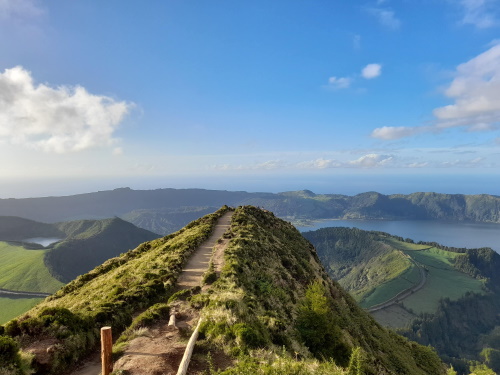
S. Miguel, Azores (Photo: Maria Vlachou)

A few days ago, I read an interview with Greek film director Sotiris Tsafoulias, in which he said: “Being an artist is not a profession. A woman who has five children, no husband, cleans stairs and still puts a bowl of water for a stray dog ​​or looks at us and says 'good morning', to me she is an artist. A person does not become an artist when they pick up a microphone, a brush or a pen. The way a person deals with ugliness, the way they metabolise it and give it back as goodness or light, the way they position themselves in the darkest moments of their life, for me, this is what makes a person an artist, regardless of profession."

Sunday, 31 October 2021

National theatres: mission (im)possible?


On the occasion of its reopening to the public, after renovation works, the National Theatre S. João (NTSJ) organised a promising international colloquium on the theme “National Theatres: missions, tensions, transformations”. In its own words, this would be “an event of multiple-voiced reflection that is also intended as a self-questioning gesture: an international conference in which we will provide an inter pares diagnosis and prognosis for an institution that, though somewhat ancient, remains very much alive.”

With his opening speech, Pedro Sobrado, Chairman of the Board, reinforced our expectations through an extensive questioning:

Sunday, 17 October 2021

Visions of the empire


Visions of the Empire is an exhibition of photography and about photography. One more exhibition in the programme of Padrão dos Descobrimentos (the Monument to the Discoveries in Lisbon), which is one of the cultural institutions that most questiones (itself and us) about the country's colonial past and about slavery. On the website of the Padrão dos Descobrimentos, one reads that “Photographic images were staged and commercialised with numerous goals. They changed hands, both officially and secretly, they were forgotten or destroyed. They documented individual and collective dreams and memories. They fuelled the imagination around colonial domination, helping to make it come true. They contributed to a vision of the “other” as essentially different ‒ regarding ways of life, customs and mentality ‒ and to the establishment and maintenance of laws and practices founded on political, social, economic and cultural discrimination and drawn along racial lines. Moreover, they served to denounce the iniquity and violence of colonisation, encouraging aspirations for a more humane and egalitarian future that spanned various political hues and orientations. Their uses in the past and their legacy in the present were ‒ still are ‒ vast, heterogeneous and long-lasting.”

Sunday, 10 October 2021

To provoke a sigh

This week, I participated in Territórios Públicos (Public Territories), the national meeting of services of education and mediation organised by 23 Miles, the cultural project of the Municipality of Ílhavo. I like the name of this initiative, which makes me think of words like “community” and “communication” – communication that creates community – the connection created by a shared task (to remember the speech “What is to love a country” by Tolentino Mendonça).

The beginning of the meeting was marked by the participation of Álvaro Laborinho Lúcio, by the worlds he brings along and generously shares in his public interventions, with a mixture of charming seriousness and captivating lightness. I could highlight several points, but, considering the theme of this post, what seems to me most relevant is to refer to the way he encouraged us to follow the impulse of our constant ignorance, which takes us from the stereotypes, to the interrogation, the questioning, the doubt…

Saturday, 3 July 2021

Propelled by love


Photo: Paulo Pimenta

The last chapter in Mike Murawski’s new book, Museums as agents of change, is entitled “Propelled by love”. While care, healing, humanity, community are very strong references in the book as a whole, it’s in that last chapter that Mike asks straightforwardly: “What if love, above everything else, was the core value that steered the radical change needed in museums today?”.